

Bone Marrow Aspiration
NanoFx®
What is NanoFx®?
NanoFx® (or Nanofracture®) is a new treatment approach to mesenchymal stem cell stimulation.
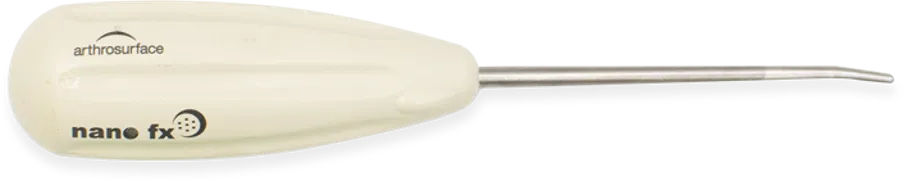
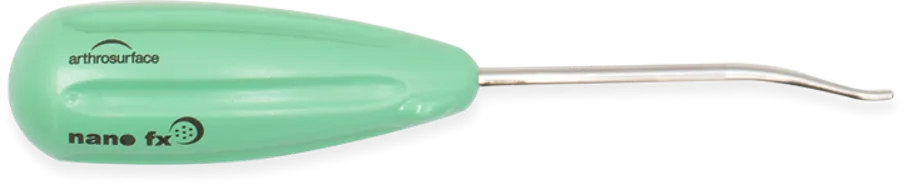
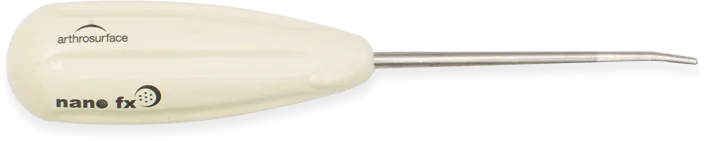
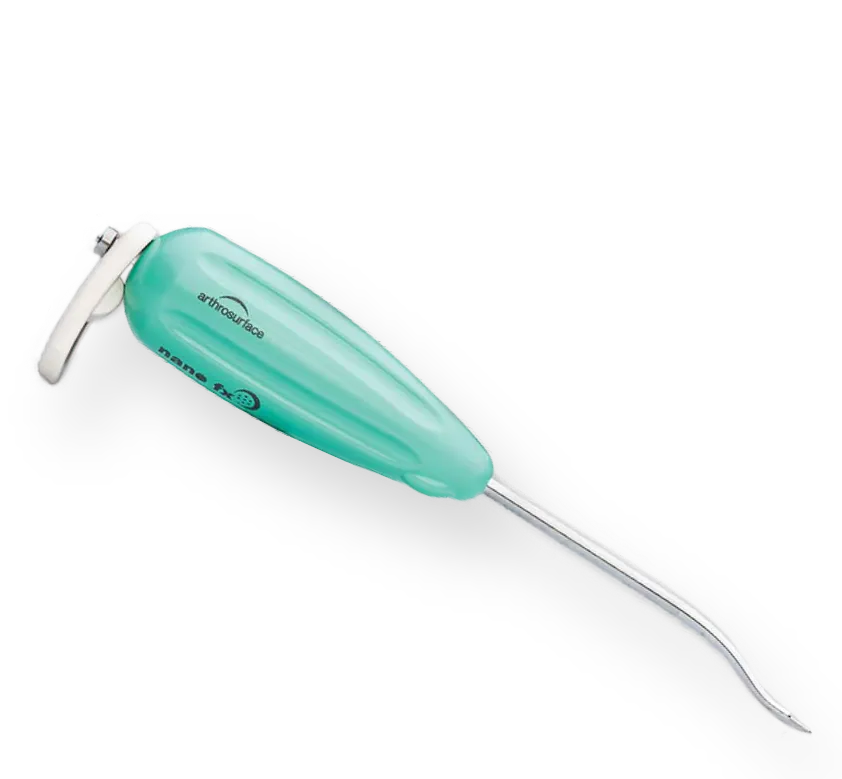
The instruments consist of a reusable Hand Instrument and a single-use disposable PleuriStik™ Guide Wire used to perform a nanofracture procedure for the treatment of small, localised articular cartilage defect sites.
Why consider NanoFx®?
To achieve the healing cartilage repair response you want, you must reach deeper to access the mesenchymal stem cells – which can transform into cartilage-producing cells to restore hyaline-like cartilage that mimics the joint’s natural cartilage.
Hover/Tap on an image to read more

Cartilage Repair
Cartilage repair focuses on joint preservation techniques. It addresses the damaged surface of the knee joint, providing pain relief and improving its natural cushioning and smoothness.

Mesenchymal Stem Cells (MSCs)
Think of MSCs as your body's versatile repair crew. They are special cells that can multiply on their own and turn into the building blocks for key parts of your skeleton, like bone or cartilage, when placed in the right setting.
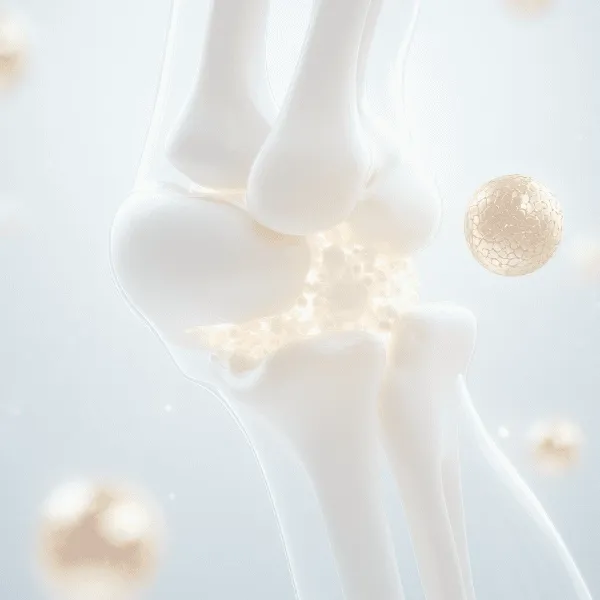
Hyaline-like Cartilage
Hyaline-like cartilage helps keep your joints moving smoothly and comfortably. Because it closely resembles your body's natural cartilage, it provides better support and long-term durability than fibrocartilage.
How does NanoFx® work?
 The 1mm PleuriStik disrupts less surface area than a standard microfracture technique and was purposefully designed to reduce damage to the subchondral plate. It penetrates down to a standardized 9mm depth to reach the targeted marrow cells, three times deeper than comparable microfracture techniques.
When tested against an awl or generic k-wire, NanoFx® resulted in thin, fragmented cancellous bone channels without rotational heat generation. It also demonstrated deep cancellous bone perforation with a higher number of open trabecular channels.
Maximising marrow cell recruitment while minimising subchondral bone damage
-

ALWAYS SHARP
The PleuriStik guide wire is always sharp as it is a single use instrument.
-

EASY ACCESS TO MARROW CELLS
The 9mm perforation depth provides deep cancellous bone perforation, improving marrow access and promoting better cartilage resurfacing.
-

LESS SUBCHONDRAL BONE DAMAGE
The 1mm PleuriStik guide wire disrupts less bone surface area compared to standard microfracture technique, reducing damage to the underlying bone surface.
-

MORE CHANNELS, MORE CELLS
Your orthopaedic surgeon can place more holes with the 1mm PleuriStik guide wire compared to the standard microfracture technique. More channels mean more MSCs for cartilage regeneration.
-

CONVENIENT TO USE
No secondary blood or marrow aspiration step is required to access MSCs.
No centrifuge or additional equipment is necessary to prepare plasma or aspirate.
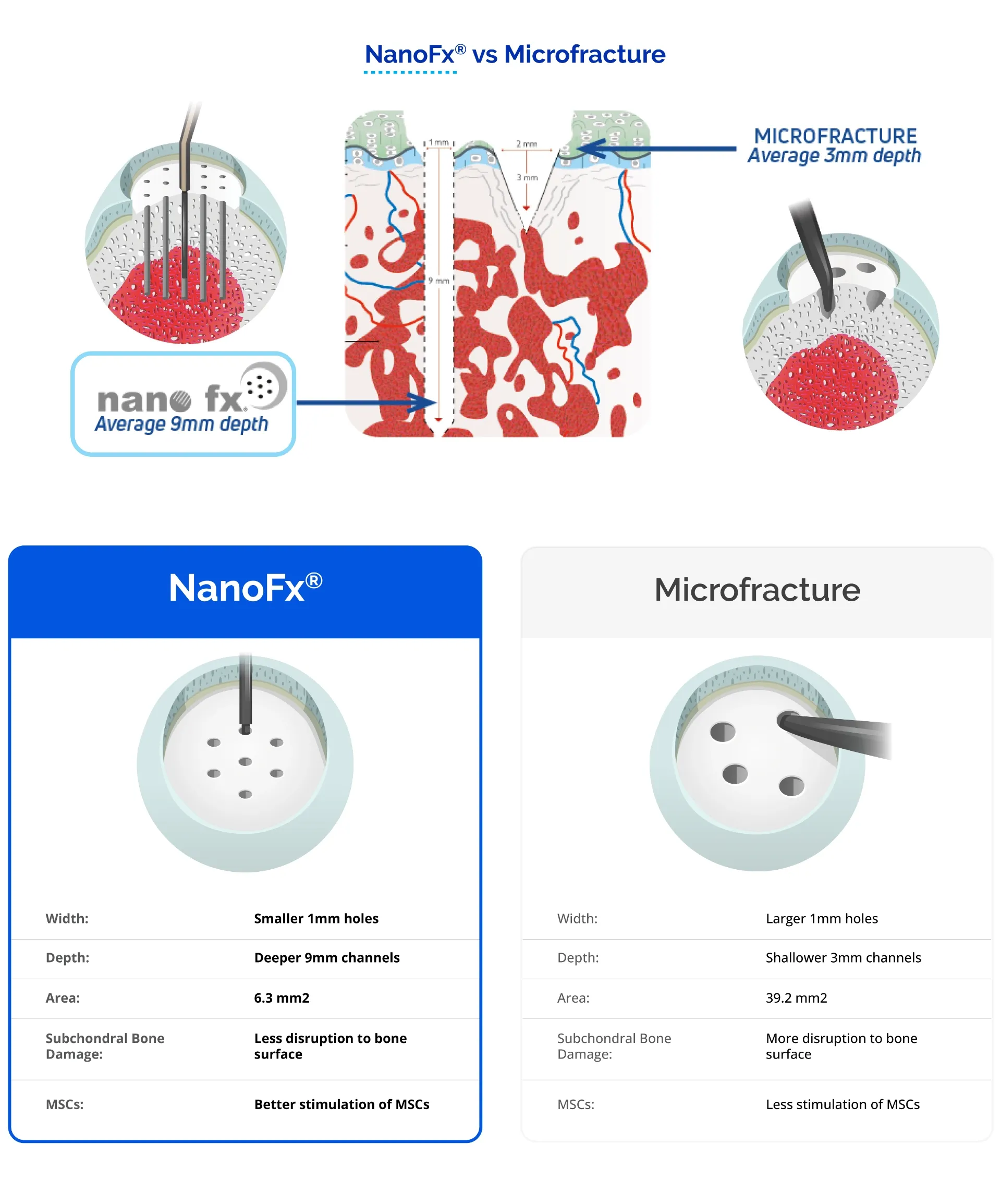
| NanoFx® | Microfracture | |
|---|---|---|
| Width: | Smaller 1mm holes | Larger 1mm holes |
| Depth: | Deeper 9mm channels | Shallower 3mm channels |
| Area: | 6.3 mm2 | 39.2 mm2 |
| Subchondral Bone Damage: | Less disruption to bone surface | More disruption to bone surface |
| MSCs: | Better stimulation of MSCs | Less stimulation of MSCs |
Clinical Studies
The Effect of Different Bone Marrow Stimulation Techniques on Human Talar Subchondral Bone: A Micro eComputed Tomography Evaluation
- Reference: Gianakos A. et al. Arthroscopy. 2016 Oct; 32(10):2110-2117
- Compared to other Bone Marrow Stimulation techniques (BMS), nanofracture results in diminished areas of destruction, sclerosis, and thickening of the subchondral bone in regions adjacent to the defect, thereby limiting the amount of perimeter compaction. BMS using larger diameter devices results in greater microarchitecture disturbances.
Footprint preparation with nanofractures in a supraspinatus repair cuts in half the re-tear rate at 1 year follow up. A randomized controlled trial
- Reference: Iban et al. Knee Surg Sports Traumatol Arthrosc (KSSTA), 2020 June. https://doi. org/10.1007/s00167-020-06073-7
- Adding nanofracture at the footprint during an isolated supraspinatus repair, lowers re-tear rate by 50% at 12-months follow-up. This is due to improved healing at the footprint
NanoFx® is available in all restructured and private hospitals
Speak with your orthopaedic surgeon to see if it’s the right option for you.
FAQs
What is NanoFx®?
NanoFx® (Nanofracture®) is a new treatment approach to mesenchymal stem cell stimulation. The instruments consists of a reusable Hand Instrument and a single-use disposable PleuriStik™ Guide Wire used to perform a nanofracture procedure for the treatment of small, localised articular cartilage defect sites.
Who can benefit from NanoFx®?
NanoFx® is ideal for people with small, localised areas of cartilage damage in a joint. These are often patients who are otherwise healthy but have a specific cartilage defect causing pain or mobility issues. Your orthopaedic surgeon will assess if NanoFx® is suitable based on the size and location of the defect.
How does NanoFx® help with knee or ankle pain?
NanoFx® reduces pain by helping your body regrow healthy cartilage in damaged joints. It creates tiny, deep holes to release mesenchymal stem cells (your body’s repair crew) that rebuild cartilage naturally.
Is NanoFx® safe for cartilage repairs?
Yes, NanoFx® is safe when performed by a trained orthopaedic surgeon. It’s a minimally invasive procedure that uses a small, sharp tool to avoid unnecessary damage to your joint.
How is NanoFx® different from traditional microfracture?
NanoFx® is like a fine needle compared to microfracture’s hammer. It uses a smaller 1mm tool to make deeper 9mm holes, reaching more repair cells with less harm to the underlying bone. This means faster recovery and stronger cartilage repair.
Can NanoFx® be used with other treatments like HYALOFAST®?
Yes! NanoFx® and HYALOFAST® are a powerful team. Think of NanoFx® as opening the door for the repair crew, while HYALOFAST® gives them a base to build strong cartilage. Together, they create a smoother, longer-lasting repair for your joints.
How long does recover take after a NanoFx® procedure?
Recovery varies depending on your injury, but most patients resume light activities, within weeks and return to daily routines in a few months. Your orthopaedic surgeon will create a recovery plan tailored to you.
What tools does NanoFx® use for hard-to-reach joint areas?
NanoFx® offers two options: a 15° angled handle for precision and an A-Curve handle, specially shaped to tackle hard-to-access ankle injuries, making it easier for surgeons to manoeuvre during the procedure.